
Table of Contents
Can Poor Posture Increase Stress Feelings? The Tension–Sleep–Mood Loop Explained
If you’re feeling stressed, tense, and exhausted, posture probably isn’t the only cause—but it can be a multiplier. The way you carry your head, shoulders, and ribcage affects how you breathe, how much muscle tension you hold, and how quickly your body can “downshift” into recovery.
That’s why posture often shows up in the same conversation as neck tension, headaches, and poor sleep. This isn’t about sitting perfectly. It’s about reducing unnecessary strain so your body isn’t fighting itself all day.
How posture can influence breathing and tension.
When the head drifts forward and the shoulders round, the front of the body compresses. That can limit ribcage expansion, encourage shallow breathing, and increase tension in the neck and upper shoulders.
Here’s why that matters: shallow, upper-chest breathing can keep your body in a more alert state. When your system stays on high alert, stress feels more intense—and your muscles tend to stay tight.
If you’ve ever noticed your shoulders rise when you’re focused, stressed, or on a screen, that’s a common pattern. Over time, this can become your default posture without you realizing it.
The tension –› poor sleep –› worse stress cycle.
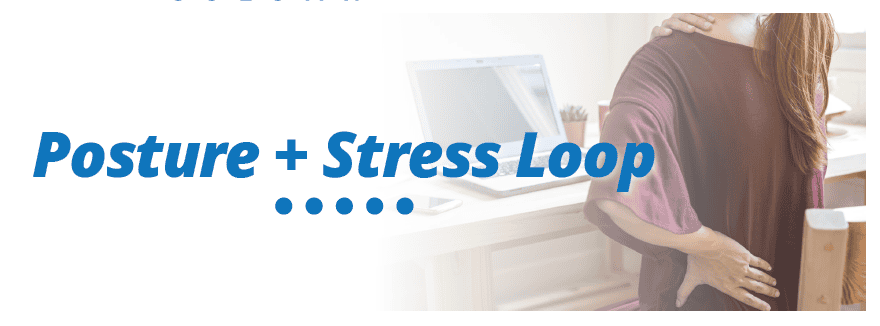
This loop is extremely common: posture strain leads to neck and shoulder tightness, tightness makes it harder to get comfortable at night, sleep becomes lighter or more interrupted, and the next day you feel more sensitive to stress and pain. Then fatigue and screen time pull your posture forward again, and the cycle repeats.
Breaking the cycle usually isn’t one perfect fix. It’s a few small changes done consistently—especially around posture, movement, and sleep.
Signs posture may be part of your stress load.
Posture may be contributing if you notice patterns like:
• Symptoms get worse late afternoon or evening.
• You feel tight after desk work or screen time.
• Your shoulders sit “up” near your ears.
• Headaches start at the base of the skull.
• You feel better after walking and moving.
These aren’t “proof,” but they’re helpful clues. The body is often consistent. If symptoms follow the same rhythm each day, that’s information.
Ergonomic fixes you can do today.
• Raise your screen so your eyes look forward, not down (books or a stand work).
• Sit back with support so your upper back isn’t doing all the work.
• Support your elbows while typing so your shoulders don’t “hover”.
• Change your phone habit—hold it higher and closer to your face instead of in your lap.
How upper cervical care may fit.
Sometimes posture strain is not just “tight muscles.” The top of the neck—especially C1 (atlas) and C2 (axis)—plays a major role in head position, posture, and how the body balances tension.
Upper cervical chiropractic focuses on these top two bones. If C1/C2 are misaligned or not functioning well, it may disrupt nerve communication between the brain and body. Since
the nervous system controls every function in the body, that disruption can contribute to compensation patterns—like chronic muscle guarding, base-of-skull headaches, and that feeling of being “wound up.”
A good upper cervical approach is conservative and specific. It isn’t about forceful twisting. It’s about identifying whether the upper neck is contributing, making a gentle correction when appropriate, and tracking progress with clear re-check points.
If you feel stuck in the tension–sleep– stress loop, the next step is clarity. Schedule an appointment with your local upper cervical chiropractor for a focused evaluation and a plan you can measure.